Discussion with AUTH Rector, Professor Kyriakos Anastasiadis
Tag: AIF 2026
Round Table: AI in Literature
Round Table: AI in Literature
Digitizing an Historical Library in the Age of Artificial Intelligence: The Joanina Library at the University of Coimbra
The Joanina Library houses a unique collection of several thousand printed books from the Early Modern era. Extending from the beginnings of typography to the end of the 18th century, this collection bears witness to the production, circulation, and organization of knowledge in that period. In addition to building a structured repository, the Joanina Digital project will provide access to all digitized content, in the form of facsimile images and text, from a collection of approximately 30,000 works that make up the Library’s Noble Floor. Digitization opens the collection to new readings and research across various disciplines, including the history of books, publishing, and libraries, as well as the history of knowledge production and circulation. The digital aggregation of the collection also enables the application of computational analysis, including the use of artificial intelligence tools.
This panel will present the Joanina Digital Project based on the following set of questions:
1) How is the large-scale digitization of a heritage library done?
1.1) How do we organize the workflow for digitizing 30,000 volumes and 18 million pages?
1.2) How do we move from bibliographic artifacts to their representation and modelling as digital artifacts?
2) For whom are we doing this large-scale digitization?
2.1) What are the uses we envision for the digital collection?
2.2.) Who will be actual users of this digital collection?
3) What is the relationship between the Joanina Library (as an architectural space for bibliographic organization) and the Joanina Digital Library (as a computational space for algorithmic modelling)?
This round table aims to provide a global perspective on this innovative project, showcasing its multiple dimensions – organizational, conceptual, technical, infrastructural, social, cognitive, and experiential.
Hippocratic Medicine and Bioethics in current clinical practice
Moderator: Vassilis Papadopoulos
AI in Military
Moderator: Stavros Tzimas
AI-Native Wireless: Designing Networks that Learn
AI-native wireless is the concept that future wireless networks will be built to learn and adapt, so connectivity becomes smarter, more reliable, and more responsive as conditions change. In this open roundtable, we’ll discuss the real-world impact of this shift: how ultra-low latency can enable safer, interconnected vehicles and the remote control of machines, how higher reliability and smarter coverage can support telemedicine, emergency response, and critical services that are always available, how more efficient use of spectrum can enable large-scale sensing and smart city infrastructure, and how energy-aware networking can make large-scale IoT deployments practical and sustainable. Throughout the discussion, we will maintain a technical focus, addressing questions such as what “networks that learn” actually means, what needs to happen across the radio access network and the wider system, and what challenges still stand in the way, including trust, security, privacy, and robustness. The goal is to have a future-focused conversation that is grounded in applications that people can envision while still providing a clear sense of the technological choices that will determine what becomes possible.
Moderator: Prof. George Karagiannidis, ECE AUTH
The Impacts of LLMs
Tools like ChatGPT, DeepSeek and Claude took the world by storm. Powered by large-scale language models (or simply large language models, or LLMs) – massive artificial neural networks, trained to understand and generate language – these tools can address numerous tasks from text summarisation and revision, to writing computer code and even translation of texts unseen before with unprecedented performance. The capabilities of these models and the easy access have facilitated their adoption in academic institutions, in the public sector and in industry. However, the fast temps of adoption, the proprietary frameworks and models which dominate the LLM landscape, lead to a knowledge gap about the actual benefits and drawbacks of this technology as well as the impacts on individuals, society, economy and environment.
This round table presents insights on the capacities of these models and tools, their underlying reasoning and learning mechanisms and facilitates a deeper discussion on their current and potential future (positive and negative) impacts on a wider-scale.
Intervention of Physics in Human Body and Mind
Panel by George Malliaras (Cambridge), Panos Patsalas (AUTh) moderator
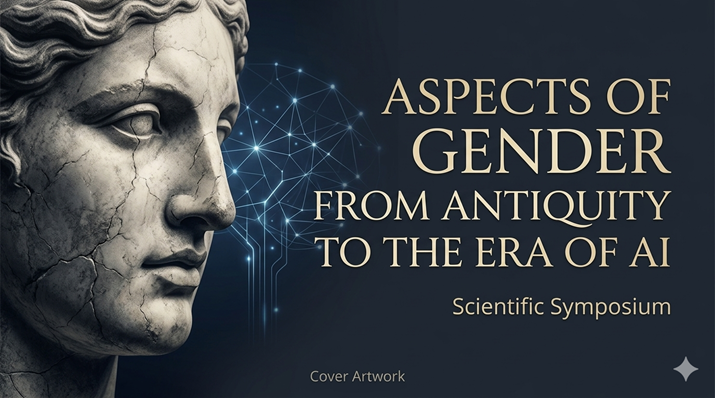
Aspects of Gender from Antiquity to the Era of AI
This workshop explores conceptions, representations, and practices of gender from antiquity to the contemporary era of artificial intelligence. Taking a long historical and theoretical view, the workshop invites participants to reflect on how ancient frameworks of gender have been constructed, transmitted, challenged, and reconfigured across time—and how they continue to inform, explicitly or implicitly, modern philosophical, social, legal, and technological discourses.
By bringing together Classical Philology, Ancient to Modern History, Philosophy, and the Social Sciences (including Anthropology, Psychology, and Constitutional Law), the workshop aims to foster interdisciplinary dialogue on gender as a category of analysis, experience, and power. Particular attention will be given to questions of continuity and rupture: what survives from ancient thought, what is transformed, and what is radically new in the age of algorithmic reasoning and AI-mediated social structures.
We welcome papers that engage with gender from antiquity to the present, including—but not limited to—the following themes:
- Gender in ancient literary, philosophical, historical, and legal texts
- Ancient theories of sex, body, and difference
- Gender, normativity, and social order in antiquity
- Reception of ancient gender concepts in later philosophical, political, or legal thought
- Gender, authority, and expertise from classical traditions to modern institutions
- Feminist, queer, or intersectional readings of ancient sources
- Gender in constitutional, psychological, sociological, or anthropological perspectives
- Gender, agency, and representation in digital culture and AI
- Continuities and discontinuities between ancient epistemologies and AI-driven models of the human
The workshop is designed as an intensive, discussion-oriented event and will take place as a satellite session of the conference Aristotle Innovation Forum: From Aristotle to AI.
See more: AIF Gender Symposium Agenda
Symposium Poster
Innovative Learning Formats and the European University of the Future. The BAUHAUS4EU experience through Student Led Courses by University of Macedonia
This session explores innovative approaches to higher education within the framework of the BAUHAUS4EU Alliance, highlighting the transformative role of Student-Led Courses in shaping the European University of the future. Through the BAUHAUS4EU experience, the discussion will focus on contemporary, student-centred and challenge-based learning models that promote interdisciplinarity, international collaboration, sustainability, creativity and active participation. Particular emphasis will be placed on how Student-Led Courses empower students to co-create educational experiences, strengthen entrepreneurial and soft skills, and contribute to regional and societal innovation ecosystems. The session will also present practical examples, collaborative methodologies and opportunities for academic staff and students to engage in innovative educational initiatives across the BAUHAUS4EU alliance.
See more at Agenda
Presentation of the University of Patras
Aristotle Innovation Forum
Thursday, 21 May 2026 | 10:30–12:00
Central Library, Aristotle University of Thessaloniki
10:30–10:45: Presentation of the University of Patras by Christos I. Bouras Rector
Postgraduate Study Programmes
10:45–11:00 Department of Educational Sciences and Early Childhood Education: Digital Governance of Educational Units & E-Learning – Digital Technologies in Education by Professor Vasileios Komis
11:00–11:10: Department of Philology: Teaching Greek as a Second/Foreign Language by Professor Georgios Xydopoulos, Dean of the School of Humanities and Social Sciences
11:10–11:30: Department of Management Science and Technology: Educational Administration, Digital Transformation of Tax and Financial Services & Digital Innovation and Management by by Associate Professor Georgios Thanasas
Spin-offs
11:30–11:40: Departments of Pharmacy, Medicine and Chemistry: ANTHESTOS PHARMACEUTICALS by Dr Evangelos Drainas, Managing Director
11:40–11:50 Departments of Materials Science and Chemistry: OLONPHOS by Professor Nikolaos Vainos Managing Director
11:55–12:00 Questions