Tag: AIF 2026
Poetic Intelligence – Discovering Poetry as a Leadership Skill
This speech introduces “Poetic Intelligence” as the essential modern “Ariadne’s Thread” for navigating a professional landscape increasingly dominated by Artificial Intelligence and cold technocratic logic, arguing that as algorithms take over analytical tasks, the human capacity for deep interpretation becomes our ultimate competitive advantage. It highlights a critical educational gap, noting that while Poetic Intelligence is absent from traditional academic curricula, there is a burgeoning international movement to integrate Poetry into University leadership programs to cultivate high-level cognitive skills. The presentation details four indispensable navigational abilities—metaphorical reasoning, sense-making, paradoxical thinking, and pattern recognition—that enable leaders to derive meaning where data alone fails. These concepts are grounded in practical experience through two case studies from experiential workshops: the analysis of Cavafy’s “The God Abandons Antony,” which redefines Change Management as the art of losing with dignity, and “Walls,” which serves as a metaphor for the limiting beliefs and cognitive biases that cloud modern decision-making. Ultimately, the speech advocates for Poetic Intelligence not as an aesthetic retreat, but as a rigorous Strategic Tool that empowers leaders to remain authentic, creative, and profoundly human in the age of AI.
Moderator: Ioannis Chrysoulakis
Ethical AI does not start in code – it starts in mindset
While much of the global AI debate is still driven by speed, scale, and competitive advantage, one recent case has made the stakes unmistakably clear. Anthropic CEO Dario Amodei has publicly defended ethical limits on AI use, refusing to remove safeguards around mass surveillance and fully autonomous weapons without human oversight. He maintained this position even as the dispute with the U.S. Department of Defense escalated into a high-profile political and commercial confrontation.
The case reveals a deeper truth: the future of AI will ultimately depend less on code and more on the mindset of those who lead it. This is the starting point of Martha Giannakoudi’s keynote.
Her keynote examines what responsible AI adoption actually requires from leaders and organisations once the buzzwords fade and real decisions begin. Her approach is practical, human-centered, and urgently relevant for organisations that want to adopt AI with clarity, accountability, and trust. As AI systems increasingly shape decisions, workflows, and human judgement, leadership responsibility is entering a new phase.Questions of responsibility, judgement, and ethical limits — central to philosophical traditions since Aristotle — are becoming practical leadership challenges for organisations working with AI today.
This leads to three central questions:
How do we take real responsibility when working with AI?
What kind of mindset is required to design and govern AI in a human-centered way?
And how can organisations balance opportunity and risk without losing their ethical compass?
Moderator: Ioannis Chrysoulakis
Piraeus Bank | Accelerating Innovation from Idea to Investment
11:30 – 12:15 | Panel Discussion: “From Idea to Market: Experiences from the 1st Cycle of the Piraeus Startup Accelerator”:
• Charalampos Tzanidis, Co-founder & CEO at SCILEND
• Panagiotis Pantazis, Co-founder & COO at SCILEND
• Thomas Bountouridis, CEO at Honestli
• Panagiotis Karadaglis, Founder at LifePulse
• Katerina Gianniki, Graphic Designer at LifePulse
• Christos Kouros, co-founded at Prooflab
Moderator: Nasos Koskinas, CEO & Founder at POS4work Innovation Hub
12:15 – 13:00 | Fireside chat: “From Idea to Funding”
• Evangelos Kosmidis, CEO at Loggerhead VC
Moderator: Nasos Koskinas, CEO & Founder at POS4work Innovation Hub
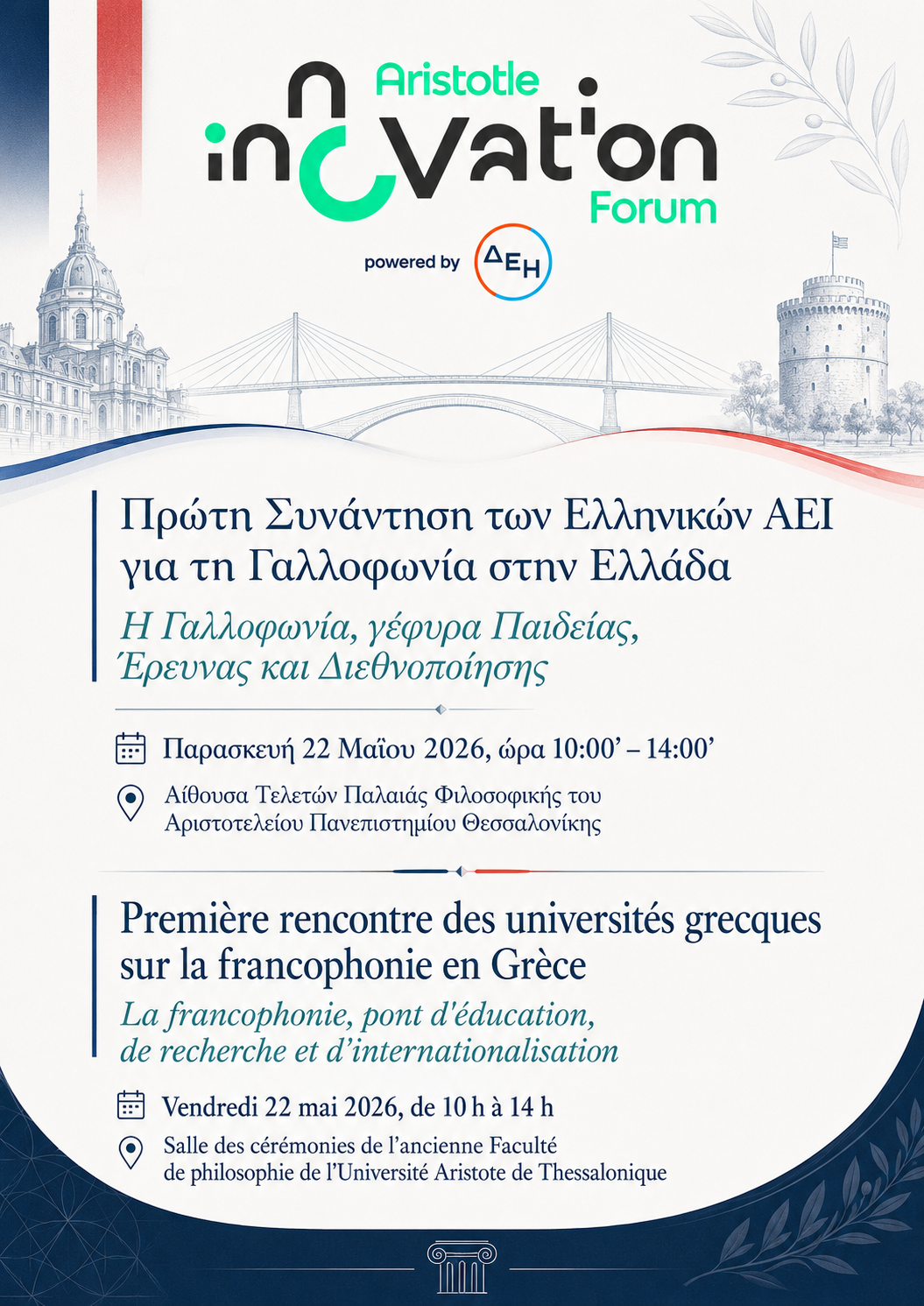
Première rencontre des universités grecques sur la francophonie en Grèce – La francophonie, pont d’éducation, de recherche et d’internationalisation
Πρώτη Συνάντηση των Ελληνικών ΑΕΙ για τη Γαλλοφωνία στην Ελλάδα
Η Γαλλοφωνία, γέφυρα Παιδείας, Έρευνας και Διεθνοποίησης
Παρασκευή 22 Μαΐου 2026, ώρα 10:00’ – 14:00’
Αίθουσα Τελετών Παλαιάς Φιλοσοφικής του Αριστοτελείου Πανεπιστημίου Θεσσαλονίκης
Première rencontre des universités grecques sur la francophonie en Grèce
La francophonie, pont d’éducation, de recherche et d’internationalisation
Vendredi 22 mai 2026, de 10 h à 14 h
Salle des cérémonies de l’ancienne Faculté
de philosophie de l’Université Aristote de Thessalonique
The event aspires to constitute the first systematic gathering of Greek Higher Education Institutions dedicated to examining the position, role, and prospects of Francophonie within Greek higher education. Its aim is not merely to offer a ceremonial tribute to the French language, but rather to shape a shared university framework for cooperation, linking Francophonie with internationalisation, research, mobility, joint study programmes, cultural diplomacy, and the positioning of Greek universities within the European academic space and their wider geographical environment in the Mediterranean and the Western Balkans.
Η εκδήλωση φιλοδοξεί να αποτελέσει την πρώτη συστηματική συνάντηση των ελληνικών ΑΕΙ γύρω από τη θέση, τον ρόλο και τις προοπτικές της Γαλλοφωνίας στην ελληνική ανώτατη εκπαίδευση. Στόχος δεν είναι απλώς μια εθιμοτυπική εκδήλωση για τη γαλλική γλώσσα, αλλά η διαμόρφωση ενός κοινού πανεπιστημιακού πλαισίου συνεργασίας, που θα συνδέει τη Γαλλοφωνία με τη διεθνοποίηση, την έρευνα, την κινητικότητα, τις κοινές σπουδές, την πολιτιστική διπλωματία και τη θέση των ελληνικών πανεπιστημίων στον ευρωπαϊκό χώρο και τον γεωγραφικό τους περίγυρο στη Μεσόγειο και τα Δυτικά Βαλκάνια.
Cet événement a pour ambition d’être la première rencontre systématique des universités grecques autour de la place, du rôle et des perspectives de la francophonie dans l’enseignement supérieur grec. L’objectif n’est pas simplement d’organiser un événement protocolaire autour de la langue française, mais de mettre en place un cadre universitaire commun de coopération, qui reliera la francophonie à l’internationalisation, à la recherche, à la mobilité, les études communes, la diplomatie culturelle et la place des universités grecques dans l’espace européen, méditerranéen et balkanique.
Coordinator Panayotis Glavinis, Professor of International Economic Law and Dean of the Faculty of Law of the Aristotle University of Thessaloniki.
Coordinateur : Panayotis Glavinis, professeur de droit économique international et doyen de la Faculté de droit de l’Université Aristote de Thessalonique.
See more at: Agenda
Orthodox Churches and the European Union: Theology in Dialogue
Artificial Intelligence and energy power in global politics: An Aristotelian analytical framework
The Citizen Science Initiative: Connecting Cities and Academia
COPE NANO Center of Excellence by Prof. Stergios Logothetidis Founder & Director, Nanotechnology Center LTFN / COPE-Nano Founder, International Nanotechnology Hub Thessaloniki
The rapid development of nanosciences and nanotechnology over the last 20–25 years, together with the discovery of organic semiconductors (Nobel Prize in Chemistry, 2000), enabled the emergence of organic printed electronics and advanced thin-film technologies. This field has introduced a new generation of lightweight, flexible, low-cost, and sustainable electronic devices with applications in energy, healthcare, sensing, and digital technologies. Through the Laboratory for Thin Films, Nanobiomaterials, Nanosystems and Nanometrology (LTFN) and the Centre of Excellence for Organic, Printed Electronics, Nanomedicine & NanoTechnologies (COPE-Nano), the Aristotle University of Thessaloniki has achieved a leading position worldwide, transforming scientific excellence into innovation through a strong ecosystem of spin-off companies and industrial applications. This integrated innovation ecosystem forms the basis of the International Nanotechnology Hub Thessaloniki (NHT), which serves as a global hub connecting research, industry, startups, education, networking, and technology transfer in nanotechnology and organic electronics. This effort has led to the development of the world’s first Ambient Digital Automated (Nano)Manufacturing Line for Organic Electronic Devices, enabling the industrial production of flexible semi-transparent Organic Photovoltaics under ambient conditions. Beyond energy generation, it opens new opportunities in flexible lighting devices, printed sensors and biosensors, wearable healthcare technologies, and low-cost printed transistors. Furthermore, the integration of automation, artificial intelligence, data-driven process optimization, and smart manufacturing architectures positions this ecosystem as a foundational model for future AI factory paradigms. The convergence of nanotechnology, organic electronics, and digital and intelligent manufacturing drives resilient, green, and digitally connected industries, supporting the transition toward a climate-neutral economy and a bright future.
Environmental Determinants of Human Health and Disease
Coordinator: Theodora Papamitsou
Environmental determinants of health and disease
Sofia Karachrysafi
Enviromental factors and intrauterine embryo development
Sotirios Sotiriou