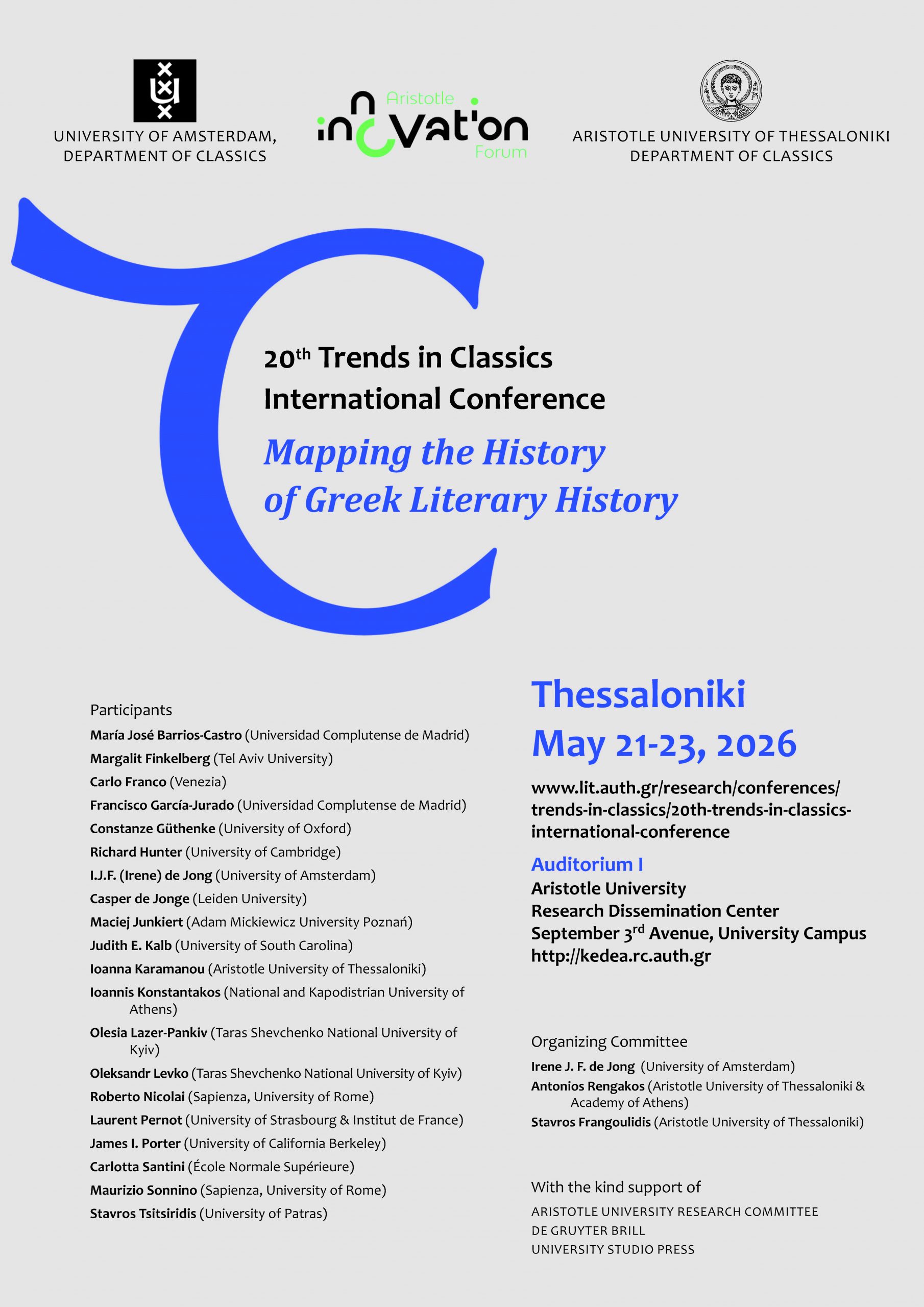
20th Trends in Classics International Conference “Mapping the History of Greek Literary History”

The conference explores the early history of literary histories of Classical Greek literature, across different periods and geographical locations.

Irene de Jong starts the conference by reflecting on the importance of Greek literary history as an object of scholarly research. The rest of Panel 1 focuses on Greek literary history in antiquity itself: James Porter discusses the Cynics as a beginning without a known beginning; Stavros Tsitsiridis examines the absence of such literary history in ancient Greece; and Roberto Nicolai considers the ancient Greek versus Roman literary-historical contribution.

Following a loose chronological order, Panel 2 includes Casper de Jonge, who explores how Dionysius of Halicarnassus produced Greek literary history for an Augustan Roman audience, and Carlotta Santini, who presents on its evolution through Friedrich Nietzsche. Along similar lines of German reception, Panel 3 features Margalit Finkelberg and Constanze Güthenke, who consider nineteenth-century Germany’s literary-historical output through the lens of a historical metanarrative and the first German literary histories, respectively.

Subsequent panels move into more contemporary territory and are geographically structured. In Panel 4, Richard Hunter looks back on the forty-year-old Cambridge History of Classical Literature, while Ioanna Karamanou and Ioannis Konstantakos focus on modern Greek outputs: the former on the agenda of the first literary histories produced in the modern Greek state, and the latter on their twentieth-century counterparts.

Panel 5 divides its interest between Italy and France. Greek literary histories issued in Italy are studied by Carlo Franco, with an emphasis on the nineteenth century, and by Maurizio Sonnino, who interprets Gennaro Perrotta’s work as a balance of opposites. Their French-produced equivalents are the object of Laurent Pernot’s talk.

Two ethnic traditions as producers of Greek literary histories also dominate Panel 6. The beginnings of Russian outputs are traced by Judith Kalb, while nineteenth-century Hispanic textbooks, from Braulio Foz to Otfried Müller, are examined by Francisco García-Jurado and María José Barrios Castro.

Lastly, Panel 7 is situated in the Slavic world. Poland is the object of Maciej Junkiert’s paper, with reference to relevant monographs by Groddeck, Węclewski and Sinko.

Olesia Lazer-Pankiv and Oleksandr Levko close the conference with a presentation on the trends of Greek literary histories issued in nineteenth- and twentieth-century Ukraine.

See the agenda and more: https://lit.auth.gr/research/conferences/trends-in-classics/20th-trends-in-classics-international-conference/ 
Brain Drain to Brain Circulation: Reimagining Greek Academia in a Networked World

Within the framework of the Forum’s central theme, the panel “Brain Drain to Brain Circulation” focuses exclusively on academia and on the strategic transformation of a national loss into a comparative advantage.

The mass exodus of Greek scientists during the years of the crisis was recorded as brain drain—a loss of talent and an outflow of invested human capital. Yet in today’s era of digital connectivity, international research consortia, and global scientific networks, the crucial question is no longer where one is located, but how well connected one is.

Greeks of the diaspora can act as bridges and agents of internationalization for Greek Higher Education Institutions, strengthening their participation in international forums, research networks, and transnational programs. In this way, the Greek university ceases to be a peripheral player and is transformed into a hub of international collaboration.

The panel features distinguished figures from the global scientific and academic community.

Drawing on their experiences, the panel will highlight how the Greek scientific presence abroad can become a strategic advantage for Greek universities, particularly in cutting-edge fields such as technology, the health sciences, space research, and the humanities.

Voices of Tomorrow: The Student Experience & the Future of Cooperation

Centering on the perspective of the next generation, this session explores the ‘Voices of Tomorrow’ and their role in shaping the future of academic cooperation. Discussions will highlight the global student experience, focusing on effective strategies for attracting international talent and providing the essential support systems needed for a thriving, diverse campus community.

How Can We Visualize The Invisible Threats of Climate Change?

How can we visualize the invisible threats of climate change? Dr. Adam Fenech, the award-winning creator of the CLIVE coastal visualization tool and shared recipient of the 2007 Nobel Peace Prize, answers this question in his talk. His presentation will delve into bridging the gap between science and society, demonstrating how innovative research and pedagogical adaptation can build global resilience against environmental risks.

Universities in the Digital Age (Rectors’ Meeting) Panel of University Rectors and Senior Leadership of Greek Higher Education Institutions

As artificial intelligence rapidly transforms research, teaching, and administration, universities face major challenges related to academic integrity, data governance, and ethical oversight. At the same time, they must balance innovation with safeguarding critical thinking, institutional autonomy, and equal access to knowledge.

European Universities and Institutional Transformation

The “European Universities” initiative marks the transition from traditional transnational cooperation to a new model of a truly integrated European university. This thematic session explores how alliances such as EPICUR contribute to institutional transformation, governance innovation, long-term sustainability, and the embedding of European values at the core of university structures.


Key topics:

  • From transnational cooperation to co-governance: what is really changing in higher education institutions
  • From European policies to the day-to-day functioning of universities
  • Institutional and legal barriers to the operation of European University Alliances
  • New roles for administration and services within European universities
  • Sustainability of alliances beyond EU funding
  • Embedding European values (academic freedom, inclusion) into the institutional core
  • Digital tools as catalysts for institutional transformation
  • Innovation beyond technology: new models of governance and collaboration
  • European Degree Programmes


Panel Chair:

Professor Nikolaos Maghioros, AUTh Vice-Rector for Academic Affairs and Development

Quality Assurance and Student-Centred Higher Education

Teaching quality and student-centred learning lie at the heart of the modern university. This thematic session highlights pedagogical innovation, the enhancement of the teaching mission, and the connection between quality and the student experience.

Key discussion topics:

  • From teaching to learning: redefining the student-centred approach
  • Innovative pedagogical practices and digital teaching tools
  • Teaching quality and evaluation based on the student experience
  • Recognising and strengthening teaching excellence in higher education institutions
  • Inclusion, universal design for learning, and equal access
  • European collaborations for enhancing teaching quality
  • Artificial Intelligence in the educational process


 AI + Engineering is a Game-Changer in Climate Crisis

AI accelerates the technologically viable, environmentally friendly  and economically competitive CO2 capture in energy intensive industry, manufacturing, and transportation. The panel explores the use of AI tools in solvent selection, process system design and optimization, operation control, and real-time emissions and environmental regulations monitoring.
 
Panos Seferlis (AUTH, Mechanical Engineering) will present how AI is enabling the deployment in industry of advanced technologies, Michael Georgiadis (AUTH, Chemical Engineering) will demonstrate the power of online optimization for energy-efficient solutions, and Evangellos Malkakis (Prefecture of Drama, Head of the Department of Environment) will discuss the use of AI in environmental protection . 

Sustainability and Green Transition in European Universities

Universities are called upon to act as key drivers of the green transition. This thematic session explores their role in implementing the European Green Deal, advancing education for sustainability, and shaping sustainable university ecosystems.


Key discussion topics:

  • Universities as “living labs” for the green transition
  • Green policies, digital solutions, and sustainable campuses
  • Education for sustainability across all disciplines
  • The social dimension of the green transition and inclusion
  • European alliances and joint sustainability strategies
  • Indicators, data, and measuring the environmental impact of higher education institutions


Panel Chair:

Professor Panagiotis Seferlis, Chair of the ERASMUS+/International Mobility Committee, Aristotle University of Thessaloniki (AUTh)


Why Artificial Intelligence Is Not a Human Brain

The claim that human thought will soon be surpassed by AI has led to a distortion of our view of the essence of humanity. We are confusing a biological system with a technological tool. Therefore, we must examine what, if any, the qualities and abilities that constitute the defining characteristics of our animal nature, and what distinguishes us from a machine that can play chess better than the world champion, make a medical diagnosis with greater accuracy than a great doctor, render a judicial decision better than an impartial and well-informed judge, or write a better doctoral dissertation than a capable doctoral candidate. Thanasis Dinopoulos