

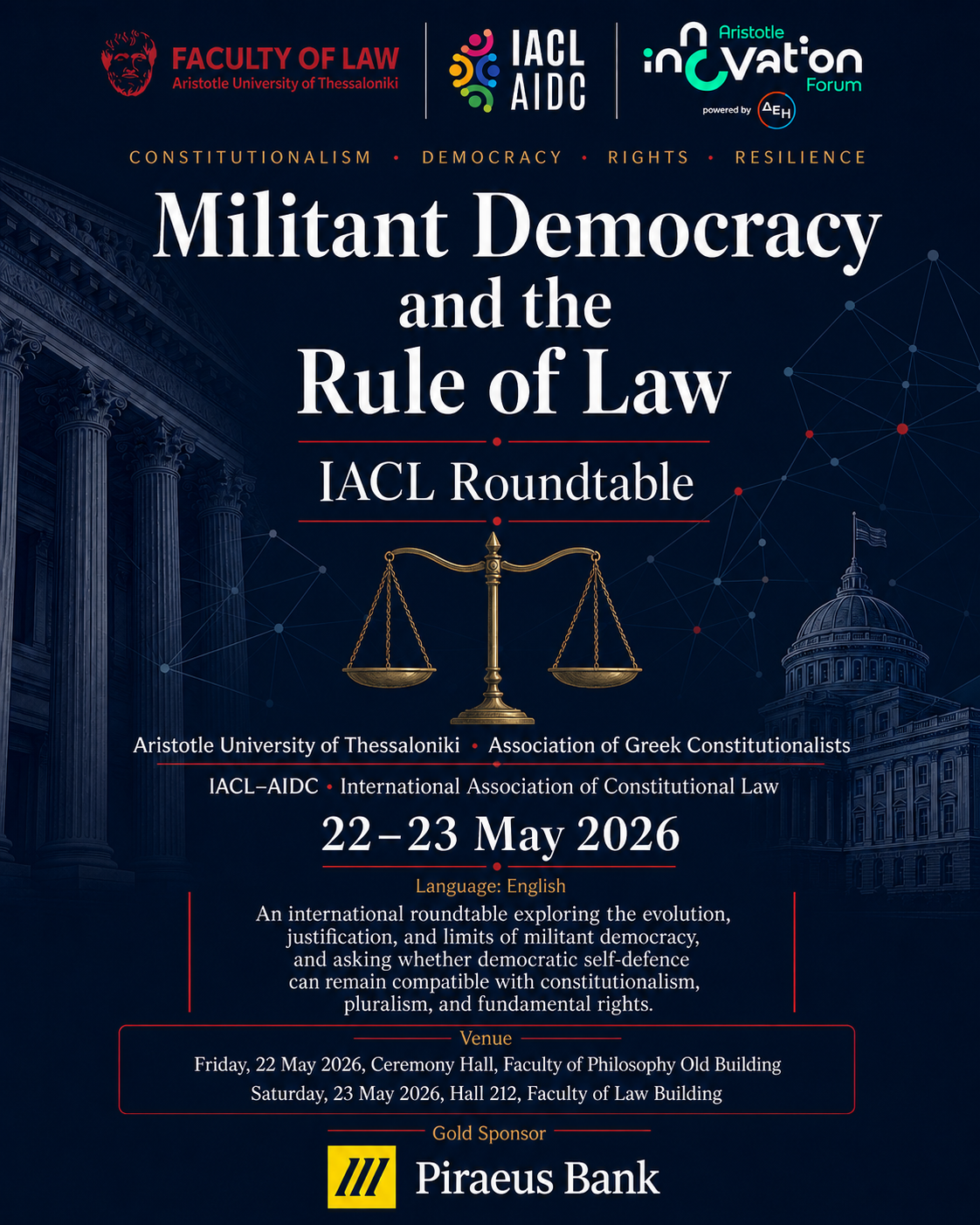
Militant Democracy and the rule of law

Date

May 22 - 23 2026

Time

5:30 pm - 5:30 pm

Labels

Satellite Event

Location

Alexandros Papanastasiou Ceremony Hall - Faculty of Philosophy Old Building
Faculty of Philosophy - Old Building - University Campus

Democratic systems have been subjected to growing pressures arising from political polarization, democratic backsliding, and declining trust in public institutions. In this context, the concept of militant democracy — understood as the right of a democratic order to defend itself against forces seeking its destruction — has regained renewed prominence. The Conference seeks to explore the evolution, justification, and limits of militant democracy, examining whether and under what conditions democratic self-defense can remain compatible with constitutionalism, pluralism, and fundamental rights. Particular attention will be paid to the role of courts, proportionality standards, procedural safeguards, and the novel challenges posed by digital disinformation, foreign interference, and authoritarian diffusion.

Kostas Chrysogonos, Professor of Constitutional Law, Faculty of Law, Aristotle University; President, Greek Association of Constitutional Law

Ioannis Sarmas, Former President, Court of Audits of Greece; Former Prime Minister of Greece

Prof. R. Howse, NYU

Prof. S. Tănăsescu, Law Faculty, Bucharest University, Chief Justice, Constitutional Court of Romania

Prof. George Katrougalos, Professor of Constitutional Law, Democritus University of Thrace, Former Foreign Minister of Greece

Prof. S. Esen, Law Faculty, Ankara University; First Vice President, IACL

See more at Agenda 
 

Who the
Speakers are:

Speakers

  • Ioannis Sarmas
    Ioannis Sarmas
    Former Prime Minister and former President of the Hellenic Court of Audit

    Ioannis Sarmas took office as President of the Hellenic Court of Audit in 2019 having served as Vice President and President of Chamber III (2013-2019). He joined the Hellenic Court of Audit in 1993, after serving as judge of the Council of State (1987-1993).
    President Ioannis Sarmas was a member of the European Court of Auditors for two consecutive terms (2002-2012). During his tenure in the ECA, he had been elected Dean of Chambers IV and I. He also served as chair of the audit committee for Europol.
    Ioannis Sarmas holds a doctorate in individual rights’ law, from the University of Paris II. He also holds postgraduate diplomas (DEA) from the University of Paris II in criminal law, public law, and public finances law, with scholarship awards from the French Government and the Hellenic Scholarships Foundation. He holds a Degree in Law from the University of Athens having graduated at the top of his class.
    Judge Ioannis Sarmas has been awarded honorary doctorates from the Aristotle University of Thessaloniki (Faculty of Law), the Panteion University of Social and Political Sciences (Department of Public Administration) and the International Hellenic University (Department of Humanities, Social Sciences and Economics).
    He has authored several law books, including leading treatises on the jurisprudence of supreme national and supra-national courts.

  • Kostas Chrysogonos
    Kostas Chrysogonos
    Professor of Constitutional Law, Faculty of Law, Aristotle University; President, Greek Association of Constitutional Law

    Kostas Chrysogonos was born in 1961 in Serres, grew up in Thessaloniki where he studied Law at Aristotle University. He earned his PhD in 1987, at the University of Hannover. In 2003 he was unanimously elected as full Professor of Constitutional Law at the University of Thessaloniki.

    He has taught in the Greek National School for Judges, the Hellenic Open University and as visiting professor in the Universities of Regensburg and Hannover. He has written approximately twenty books and over eighty scientific studies in law journals or collective works in Greek, English and German. He also writes frequently in the daily press and pursuing an active law practice.

  • Robert Howse
    Robert Howse
    Lloyd C. Nelson Professor of International Law, New York University (NYU)

    Robert Howse is the Lloyd C. Nelson Professor of International Law at NYU School of Law. His teaching and research focus on international economic law (trade, investment, and finance) and legal and political philosophy. He is a co-founder and co-convener of the New York City Area Working Group on International Economic Law. Professor Howse’s article with Ruti Teitel “Beyond Compliance: Rethinking Why International Law Really Matters” was awarded the Global Policy Best Article Prize 2010 (shared with Joseph Stiglitz et al).

    Recent representative publications of Professor Howse include: “Necessary Justice: ‘Political’ Trials and Modern Political Philosophy,” Cardozo Law Review, 2025, “Continuity and Change in the World Trade Organization: Pluralism Past, Present and Future,” (co-author with Joanna Langille) American the Journal of International Law, 2023, “Epilogue: In Defense of Disruptive Democracy: A Critique of Anti-Populism,” International Journal of Constitutional Law (2019); “International Investment Law and Arbitration: A Conceptual Framework”, in International Law and Litigation: A Look at Procedure (2019), “The WTO 20 Years On: Global Governance by Judiciary”, European Journal of International Law (2016); The Legitimacy of International Trade Courts and Tribunals (co-editor), Cambridge University Press (2018).

    Professor Howse has been a visiting fellow at the London School of Economics and visiting professor at Harvard Law School, Tel Aviv University, the Hebrew University of Jerusalem, the University of Paris 1 (Pantheon-Sorbonne), and Osgoode Hall Law School in Canada, among other institutions.

  • Simina Tănăsescu
    Simina Tănăsescu
    Professor at Law Faculty, Bucharest University, Chief Justice, Constitutional Court of Romania

    Judge Simina Tănăsescu, a faculty member at the University of Bucharest’s Faculty of Law, has been elected as the new President of the Constitutional Court of Romania (CCR). Professor Dr. Simina Tănăsescu will serve a three-year term in this role.

    Appointed to the CCR in 2019 by the President of Romania for a nine-year mandate, Professor Dr. Tănăsescu is a graduate of the Faculty of Law at the University of Bucharest (Class of 1991). She earned her PhD with the distinction “Très bien avec les félicitations du jury” from the Faculty of Law and Political Science at Aix-Marseille III University in France (1997).

    With extensive academic and professional experience, Professor Dr. Tănăsescu teaches courses at the University of Bucharest’s Faculty of Law in Constitutional Law, Constitutional Litigation, the Normative System of the European Union, and Legal Research Methodology. Since 2006, she has supervised doctoral and postdoctoral work in legal sciences.

    She has participated as a director, researcher, or national rapporteur in numerous nationally and internationally funded projects. Professionally, she has represented the Romanian state in various European institutions, including the European Commission Delegation in Bucharest, the European Union Agency for Fundamental Rights, and the Council of Europe’s Group of Independent Experts. Between 2009 and 2011, she also served as the civil society representative on Romania’s Superior Council of Magistracy (CSM).

    Throughout her career, she has served as a trainer at the National Institute of Magistracy (2004–2019) and at the European Institute of Romania (2005–2019). She has also been a visiting professor at several European universities, including the University of Poitiers, the University of Bordeaux, and the University of Paris I Panthéon-Sorbonne.

    In recognition of her scholarly work, she received the “Andrei Rădulescu” Award from the Union of Jurists of Romania in 2002 for her book Interpretarea Constituției. Teorie și practică (Interpreting the Constitution: Theory and Practice), and in 2008, the same institution awarded her the “Hanibal Teodorescu” Prize for Constituția României – comentariu pe articole (The Romanian Constitution – Article-by-Article Commentary).

    In 2011, she was decorated by the President of the French Republic with the Ordre national du Mérite at the rank of Knight, and in 2018, she was awarded the Légion d’honneur, also at the rank of Knight.

  • George Katrougalos
    George Katrougalos
    Professor of Constitutional Law, Democritus University of Thrace, Former Foreign Minister of Greece

    George Katrougalos is professor of public law at Democritus University of Thrace, former foreign minister of Greece. He is Vice-President of the International Association of Constitutional Law (IACL), with expertise on Human Rights, Comparative Constitutional Law, Democracy, Social Rights and Social Policy.

    Katrougalos completed his law degree in Athens Law Faculty and his Master’s degree and Ph.D. in Paris I, Pantheon Sorbonne. He has taught at many universities in Europe, USA and Asia. He has been Emil Noel Fellow and Senior Emile Noel at New York University (2007 and 2012) and visiting professor at Roskilde University (1994-1995), as a fellow of the Danish Academy of Science. He has practiced in international tribunals, advised governments and the Council of Europe and worked on institution building in many countries in Europe and Asia. He has published extensively in Greek, American and European legal reviews.

    Katrougalos served as member of the European and the Greek Parliament, Minister of Foreign Affairs of Greece, State Minister for European Affairs, Minister of Labor and Social Solidarity and State Minister for Administrative Reforms. He was President of the Unified European Left at the Parliamentary Assembly of the Council of Europe and President of the Sub-Committee on the Arab World and the Middle East of PACE.

  • Selin Esen
    Selin Esen
    Professor of Law Faculty, Ankara University; First Vice President, IACL

    Selin Esen is the full professor of constitutional law in the Ankara University, Faculty of Law. She was an academic consultant in the Constitutional Reconciliation Committee formed by the Turkish Parliament to draft a new constitution during 2012-1013. She is the member of the executive committee of the International Association of Constitutional Law and vice president of the Asociación Mundial de Justicia Constitucional. She has several publications on judicial review, secularism, political parties, fundamental rights and freedoms and emergency regimes.

    In 2018, Esen will research internet freedom from the comparative constitutional law perspective, at the Max Planck Institute Luxembourg.