
Humanity’s Epoch of Space: What we learned after nearly 70 years of Exploration

Date

May 20 2026

Time

4:00 pm - 4:30 pm

Labels

Main Event Hall A

Location

Pavilion 15 Thessaloniki International Fair
Egnatias 154, TIF, Thessaloniki 546 36
Website
https://thessalonikifair.gr/el

The Epoch of Space started on October 4, 1957 with the launch of the first satellite,
Sputnik, by the then Soviet Union. Since that time, we have sent spacecraft to
explore the Moon, the Sun, Asteroids, Comets, every planet in our solar system,

and even crossed the border with the Galaxy with Voyager 1 & 2. Further, space-
based telescopes such as Hubble and James Webb have revealed unimagined

phenomena such as neutron stars and black holes, including the presence of
galaxies within 300 million years after the Bib Bang that theory tells us should not
exist. This talk will focus on discoveries in our own solar system, describe some of
the most important findings about the Universe, and discuss the probability of
biological activity in other solar systems of our own galaxy, and the Cosmos at
large.

Who the
Speakers are:

Speaker

  • Stamatios Krimigis
    Stamatios Krimigis
    Emeritus Head of the Space Exploration Sector at the Johns Hopkins Applied Physics Laboratory (APL)

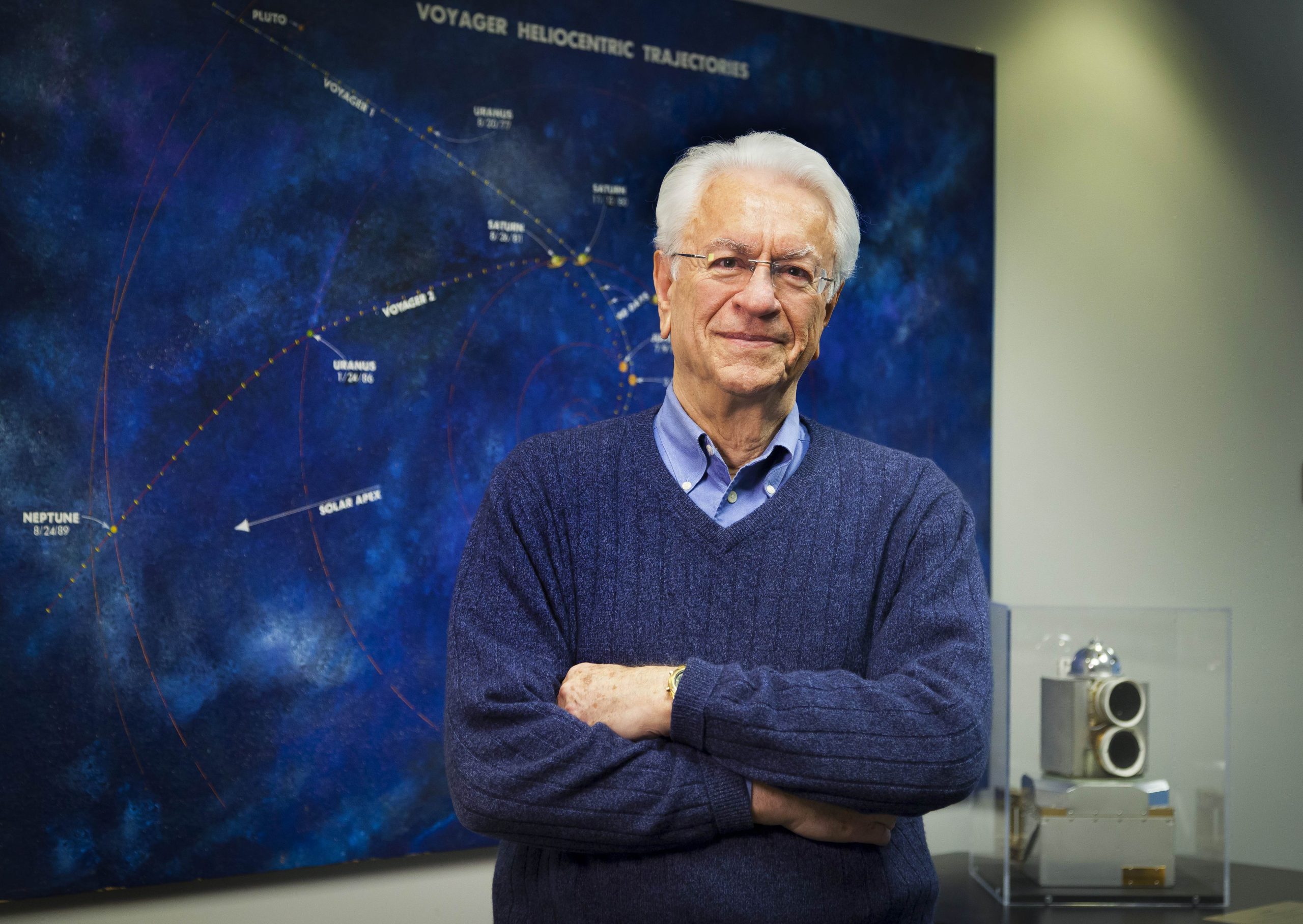
    Dr. Stamatios (Tom) Krimigis is Emeritus Head of the Space Exploration Sector at the Johns Hopkins Applied Physics Laboratory (APL), President of the Academy of Athens (2024) where he occupies the Chair of Science of Space and Applications, has built instruments that have flown to all 9 classical planets beginning with Mariner 4 to Mars in 1965 and ending with New Horizons to Pluto in 2015; also the Moon, the asteroid Eros, and the Parker Solar Probe to the Sun in 2018, and is Principal Investigator on NASA’s Voyager 1 and 2 Interstellar Mission to the outer planets and the Galaxy. In 1999 the International Astronomical Union named asteroid 1979 UH as 8323 Krimigis. Among his recent awards are the Smithsonian Institutions’ National Air and Space Museum Trophy for Lifetime Achievement (2015), the NASA Distinguished Public Service Medal (2016), and the Theodore von Karman Award (2017) of the International Academy of Astronautics. He is a member of Academia Europaea, and was honored by a special resolution of the U. S. Senate “for exceptional contributions to space science” (2018). A short video on his career produced by the Smithsonian can be found at
    (https://www.youtube.com/watch?v=lvqtPPy6bQg)