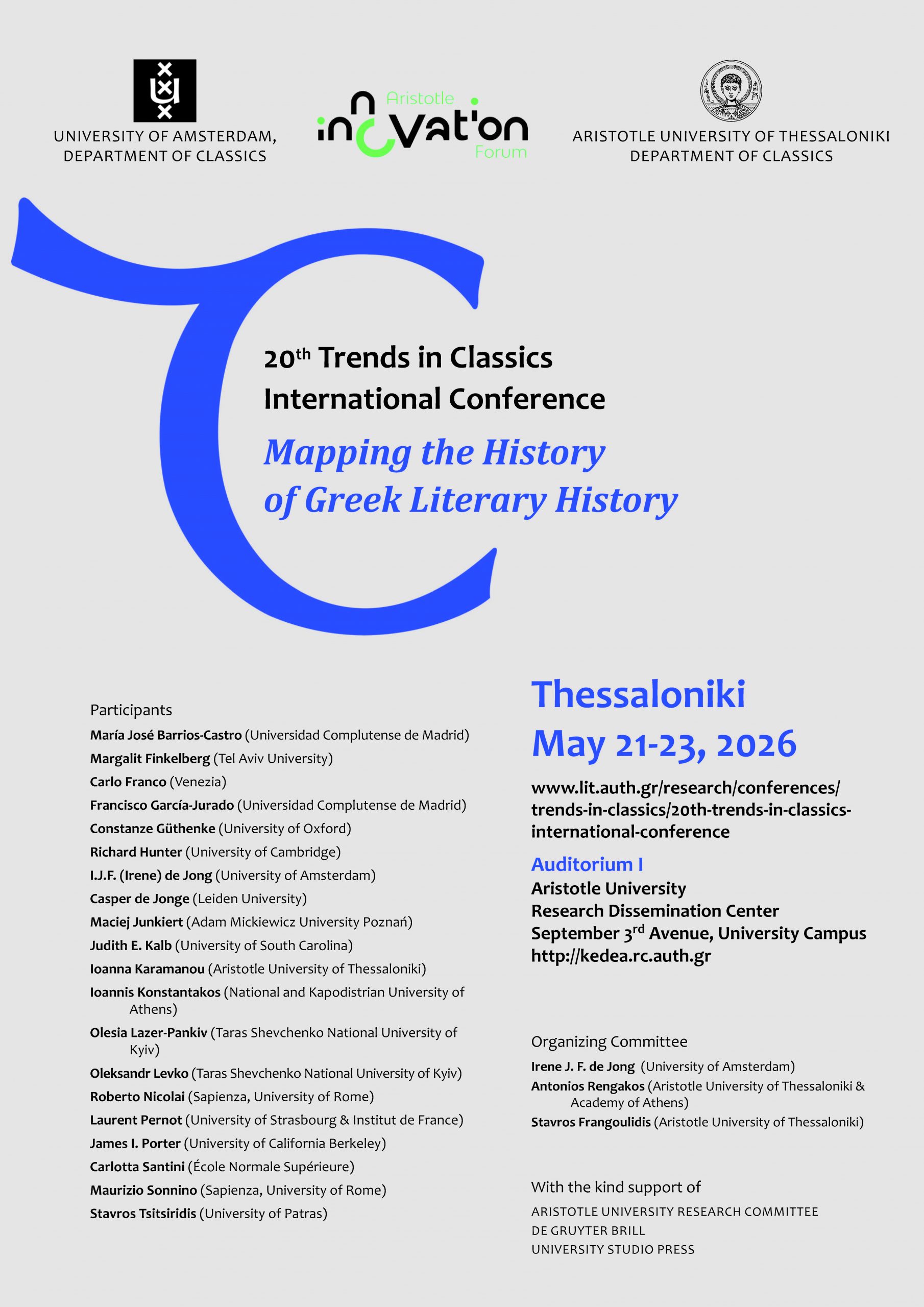


The conference explores the early history of literary histories of Classical Greek literature, across different periods and geographical locations.
Irene de Jong starts the conference by reflecting on the importance of Greek literary history as an object of scholarly research. The rest of Panel 1 focuses on Greek literary history in antiquity itself: James Porter discusses the Cynics as a beginning without a known beginning; Stavros Tsitsiridis examines the absence of such literary history in ancient Greece; and Roberto Nicolai considers the ancient Greek versus Roman literary-historical contribution.
Following a loose chronological order, Panel 2 includes Casper de Jonge, who explores how Dionysius of Halicarnassus produced Greek literary history for an Augustan Roman audience, and Carlotta Santini, who presents on its evolution through Friedrich Nietzsche. Along similar lines of German reception, Panel 3 features Margalit Finkelberg and Constanze Güthenke, who consider nineteenth-century Germany’s literary-historical output through the lens of a historical metanarrative and the first German literary histories, respectively.
Subsequent panels move into more contemporary territory and are geographically structured. In Panel 4, Richard Hunter looks back on the forty-year-old Cambridge History of Classical Literature, while Ioanna Karamanou and Ioannis Konstantakos focus on modern Greek outputs: the former on the agenda of the first literary histories produced in the modern Greek state, and the latter on their twentieth-century counterparts.
Panel 5 divides its interest between Italy and France. Greek literary histories issued in Italy are studied by Carlo Franco, with an emphasis on the nineteenth century, and by Maurizio Sonnino, who interprets Gennaro Perrotta’s work as a balance of opposites. Their French-produced equivalents are the object of Laurent Pernot’s talk.
Two ethnic traditions as producers of Greek literary histories also dominate Panel 6. The beginnings of Russian outputs are traced by Judith Kalb, while nineteenth-century Hispanic textbooks, from Braulio Foz to Otfried Müller, are examined by Francisco García-Jurado and María José Barrios Castro.
Lastly, Panel 7 is situated in the Slavic world. Poland is the object of Maciej Junkiert’s paper, with reference to relevant monographs by Groddeck, Węclewski and Sinko.
Olesia Lazer-Pankiv and Oleksandr Levko close the conference with a presentation on the trends of Greek literary histories issued in nineteenth- and twentieth-century Ukraine.
See the agenda and more: https://lit.auth.gr/research/conferences/trends-in-classics/20th-trends-in-classics-international-conference/